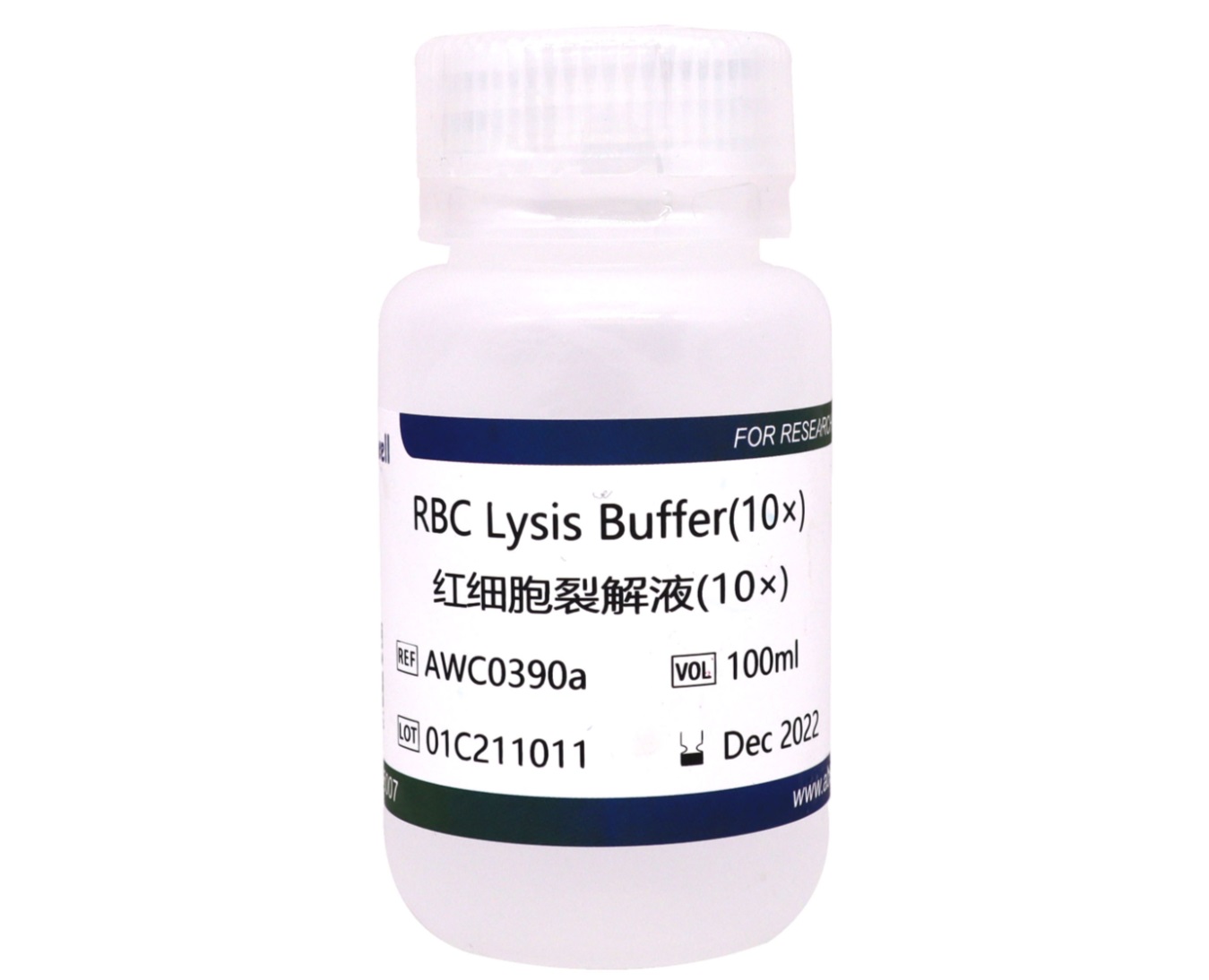
| 名称 | 货号 | 规格 | storage |
|---|---|---|---|
| 红细胞裂解液(RBC Lysis Buffer,10×) | AWC0390-100ml | 100ml | 2-8℃ |
| 红细胞裂解液(RBC Lysis Buffer,10×) | AWC0390-500ml | 500ml | 2-8℃ |
红细胞裂解液(RBC Lysis Buffer,10×)
产品简介:
在生物科研领域,经常需要去除红细胞,去除红细胞的方法有多种,如ACK Lysis Buffer、Tris-氯化铵细胞裂解液、Gey's Lysis Buffer。红细胞裂解液(Red Blood Cell Lysis Buffer)是一种从人、鼠或其他哺乳动物等体内的组织样品或血液中裂解并去除无核红细胞的溶液,其主要有效成分为NH4Cl。
RBC Lysis Buffer(10×)配方经过优化不同于ACK Lysis Buffer,在裂解无核红细胞的同时几乎不损伤淋巴细胞(Lymphocyte)或其它有细胞核的细胞。对于裂解、去除有细胞核红细胞,例如鸟或禽类的红细胞,效果不佳,裂解类似细胞时,不建议采用。该裂解液经过滤除菌,为10×的浓缩液,使用1×RBC Lysis Buffer处理过的血液或组织细胞样品可以用于后续的细胞培养、细胞融合以及核酸或蛋白的提取及各种常规的分析和检测,尤其适用于流式细胞检测或需要高浓度裂解液的情况。
自备材料:
1、 胰蛋白酶
2、 离心机
3、 PBS、HBSS、生理盐水或血清培养液
操作步骤(仅供参考):
注意:绝大多数情况下,应使用无菌去离子水稀释RBC Lysis Buffer(10×)至1×使用。
(一)组织细胞样本的常规操作
1、 制备细胞悬液:新鲜组织经过胰蛋白酶或胶原酶等消化处理,通过适当方法制备成细胞悬液,离心弃上清。
2、 裂解:加入3~5倍细胞沉淀体积的1×RBC Lysis Buffer,轻柔吹打混匀,裂解1~2min。本操作步骤在4℃条件下操作更佳,亦可在室温下操作。
3、 离心:4℃,400~500g离心5min,弃红色上清。本步骤亦可在室温下操作。
4、 如果发现红细胞裂解不完全,可以重复上述步骤2和步骤3各一次。
5、 洗涤:根椐实验要求加入适量PBS、HBSS、生理盐水或无血清培养液,轻柔混匀重悬沉淀。4℃,400~500g离心2~3min,弃上清,该离心步骤亦可在室温下操作。所加入PBS、HBSS、生理盐水或无血清培养液的量一般应大于细胞沉淀体积的5倍以上。
6、 如有必要,重复上述步骤5一次,共洗涤1~2次。
7、 根据实验需要用适当溶液重悬细胞沉淀,进行计数、培养等后续实验。
(二)组织细胞样本的快速操作(无需洗涤)
1、 制备细胞悬液:新鲜组织经过胰蛋白酶或胶原酶等消化处理,制备细胞悬液,离心弃上清。
2、 裂解:加入5倍细胞沉淀体积的1×RBC Lysis Buffer,轻柔吹打混匀,裂解1~2min,本操作步骤在4℃条件下操作更佳,亦可在室温下操作。
3、 加入15~20ml PBS、HBSS、生理盐水或无血清培养液,轻柔混匀。
4、 离心:4℃,400~500g离心5min,弃红色上清,本离心步骤亦可在室温下操作。
5、 如果发现红细胞裂解不完全,可以重复上述步骤2~4一次。
6、 根据实验需要用适当溶液重悬细胞沉淀,进行计数、培养等后续实验。
(三)血液样本的常规操作
1、 取新鲜抗凝血,400~500g离心5min,弃红色上清。
2、 裂解:加入6~10倍细胞沉淀体积的1×RBC Lysis Buffer,轻柔吹打混匀,裂解1~5min。本操作步骤在4℃条件下操作更佳,亦可在室温下操作。(特别提醒:对于鼠的血液,裂解1~2min已经足够,对于人的外周血,宜延长裂解时间至4~5min,并且裂解过程中轻轻摇动以促进红细胞裂解。)
3、 离心:4℃,400~500g离心5min,弃红色上清,本步骤亦可在室温下操作。
4、 如果发现红细胞裂解不完全,可以重复上述步骤2和步骤3一次。
5、 洗涤:根椐实验要求加入适量PBS、HBSS、生理盐水或无血清培养液,轻柔混匀重悬沉淀。4℃,400~500g离心2~3min,弃上清,该离心步骤亦可在室温下操作。所加入PBS、HBSS、生理盐水或无血清培养液的量一般应大于细胞沉淀体积的5倍以上。
6、 根据实验需要用适当溶液重悬细胞沉淀,进行计数、培养等后续实验。
注意:对于微量或少量的血液样本,可以不用第1步操作,可直接加入10倍血液体积的ACK Lysis Buffer进行第2步操作,并在4℃裂解4~15min。对于鼠的血液,裂解4~5min已经足够;对于人的外周血,宜延长裂解时间至10min,但通常不宜超过15min,并且裂解过程中宜适当摇动以促进红细胞裂解。
(四)血液样本的快速操作(无需洗涤)
1、 新鲜抗凝血中加入10倍体积的1×RBC Lysis Buffer,轻轻吹打混匀,裂解4~15min。本操作步骤在4℃条件下操作更佳,亦可在室温下操作。(特别提醒:对于鼠的血液,裂解4~5min已经足够,对于人的外周血,宜延长裂解时间至10min,但通常不宜超过15min,并且裂解过程中宜适当摇动以促进红细胞裂解。)
2、 加入20~30ml PBS、HBSS、生理盐水或无血清培养液,轻柔混匀。
3、 400~500g离心5min,弃红色上清,4℃离心效果更佳。
4、 如果发现红细胞裂解不完全,可以重复上述步骤2和步骤3一次。
5、 根据实验需要用适当溶液重悬细胞沉淀,进行计数、培养等后续实验。
注意事项:
1、 制备细胞悬液时应根据实验需要,不一定要制备成单细胞悬液。
2、 后续试验如果是用于细胞培养,操作过程中应注意无菌操作,尽量在超净工作台内操作。
3、 离心步骤尽量在4℃离心机上操作。
4、 常规步骤与快速步骤的区别在于:常规步骤多了一步洗涤过程的离心,可以节省洗涤液的用量,并且洗涤效果也更好,不需要大体积的离心管;快速步骤少了一次离心过程,洗涤效果略差一些,同时需要大体积的离心管。
5、 离心洗涤后,通常极微量的红细胞不会影响后续的检测。
6、 如果经过1×RBC Lysis Buffer处理后的样品后续用于总RNA的提取,在处理细胞时不必使用DEPC处理的溶液,即无需在该操作中特意去除RNase。
7、 为了您的安全和健康,请穿好实验服并佩戴一次性手套和口罩操作。
8、 本产品仅限于专业人员的科学研究用,不得用于临床诊断或治疗,不得用于食品或药品,不得存放于普通住宅内。
注意:
1.本产品仅供科研使用。请勿用于医药、临床诊断或治疗。食品及化妆品等用途。请勿存放于普通住宅区。
2为了您的安全和健康,请穿好实验服并佩戴一次性手套和
参考文献 (4)
Pre-eclampsia is a major cause of maternal and fetal mortality. Low molecular weight heparin sodium (LMWH) reduced the incidence of pre-eclampsia, may be an effective treatment of pre-eclampsia. But the underlying mechanism of LMWH was unknown. To improve the molecular utilization rate, Chitosan-LMWH nanoparticles (CHsN) were purchased for the study. The prague of pregnancy Sprague-Dawley rats were injected with nitroso L-arginine methyl ester to construct a pre-eclampsia model. Trichotrophoblast cells HTR-8/SVneo were cultured under Hypoxia/reoxygenation injury (H/R) simulation conditions to construct the cell model. CHsN ameliorated the integrity of fetal membrane tissue. Administration of CHsN resulted in decreased urine protein and HB-EGF levels, accompanied by increased numbers of pups and placenta. Treatment with CHsN increased the proportion of Treg cells and decreased the proportion of Th17 cells. After treatment with CHsN, the levels of LPS, TNF-α, rank1, slp1, Foxo, NF-κB, and HIF-1α were down-regulated, while the levels of IL-2, Foxp3, and TGFβ1 were up-regulated. CRM197 reversed the effect of CHsN. The CHsN improved H/R-induced HTR-8/SVneo cells apoptosis through HB-EGF and affected CD4+T cell differentiation. CHsN ameliorated pre-eclampsia by regulating Treg/Th17 immune balance and inflammation at the maternal-fetal interface through HB-EGF. This provided a theoretical reference for relieving pre-eclampsia by CHsN. This article is protected by copyright. All rights reserved
Background Postmenopausal osteoporosis (PMO) is a chronic condition characterized by decreased bone strength. This study aims to investigate the effects and mechanisms of the combination of Butyricicoccus pullicaecorum ( Bp ) and 3-hydroxyanthranilic acid (3-HAA) on PMO. Methods The effects of Bp and 3-HAA on PMO were evaluated in ovariectomized (OVX) rats by assessing stereological parameters, femur microstructure, and autophagy levels. The T helper (Th) 17/Regulatory T (Treg) cells of rats were detected using flow cytometric analysis. Furthermore, the impact of Bp and 3-HAA on the gut microbiota of rats was assessed using 16S rRNA gene sequencing. The correlation between the gut microbiota of rats and Th17/Treg immune factors, as well as femoral stereo parameters, was separately assessed using Spearman rank correlation analysis. Results Bp and 3-HAA treatments protected OVX rats by promoting osteogenesis and inhibiting autophagy. Compared to the Sham group, OVX rats showed an increase in Th17 cells and a decrease in Treg cells. Bp and 3-HAA reversed these changes. Enterorhabdus and Pseudomonas were significantly enriched in OVX rats. Bp and 3-HAA regulated the gut microbiota of OVX rats, enriching pathways related to nutrient metabolism and immune function. There was a correlation between the gut microbiota and the Th17/Treg, as well as femoral stereo parameters. The concurrent administration of Bp and 3-HAA medication facilitated the enrichment of gut microbiota associated with the improvement of PMO. Conclusion The combination therapy of Bp and 3-HAA can prevent PMO by modulating the gut microbiota and restoring Th17/Treg immune homeostasis.
Background Neutrophilic asthma (NA) is an allergic airway inflammation disease featuring heterogeneous neutrophil infiltration, which is driven by the interactions between dendritic cells (DCs) and T helper (Th) 17 cells. Neutrophils release neutrophil extracellular traps (Nets), which promote disease progression and glucocorticoid resistance. Therefore, targeting the interaction among Nets, DC and Th17 is a promising pathway for preventing organ damage. Traditional Chinese Medicine (TCM), especially Xiao-qing-long-tang (XQLT), has shown potential in managing eosinophilic asthma by modulating Th2 cell-mediated inflammation, reducing eosinophilic infiltration, and airway remodeling. However, XQLT’s effect on Nets and DCs-Th17 interactions in NA remains unclear. Methods We developed two models: an ovalbumin (OVA)/lipopolysaccharide (LPS)-induced NA mouse model with interventions using either XQLT or sivelestat, and a series of bone marrow-derived dendritic cells (BMDCs)-Th17 cell differentiation models induced by Nets, OVA/LPS, OVA/LPS/Nets, XQLT, OVA/LPS/Nets/XQLT, or corresponding inhibitors. The chemical composition of XQLT was analyzed using ultra-performance liquid chromatography-mass spectrometry (UPLC-MS). Key parameters were evaluated via histopathology, immunohistochemistry, immunofluorescence scanning, flow cytometry, Western blot (WB) analysis, and enzyme-linked immunosorbent assay (ELISA). Results In OVA/LPS-induced mice, treatment with sivelestat in OVA/LPS-induced mice reduced airway inflammation, Nets formation characterized by citrullinated histone H3 (CitH3) and myeloperoxidase (MPO) expressions, Th2/17 cell proportions in lungs, and interleukin (IL)-4, 6, 17, and 23 levels in bronchoalveolar lavage fluid (BALF). In vitro, OVA/LPS/Nets promoted IL-6/23 secretions and Th17 differentiation through increased p38 mitogen-activated protein kinase (MAPK)/nuclear factor κB (NF-κB) signaling phosphorylation in DCs. Fifty-one compounds were identified in XQLT, with 11 predicted to bind MAPK proteins with high affinity. XQLT significantly inhibited Nets-DCs-Th17 Axis and p38MAPK/NF-κB signaling in both NA mouse and cell models. Conclusion XQLT offered a promising treatment strategy for regulating the Nets-DCs-Th17 axis in NA.