产品介绍
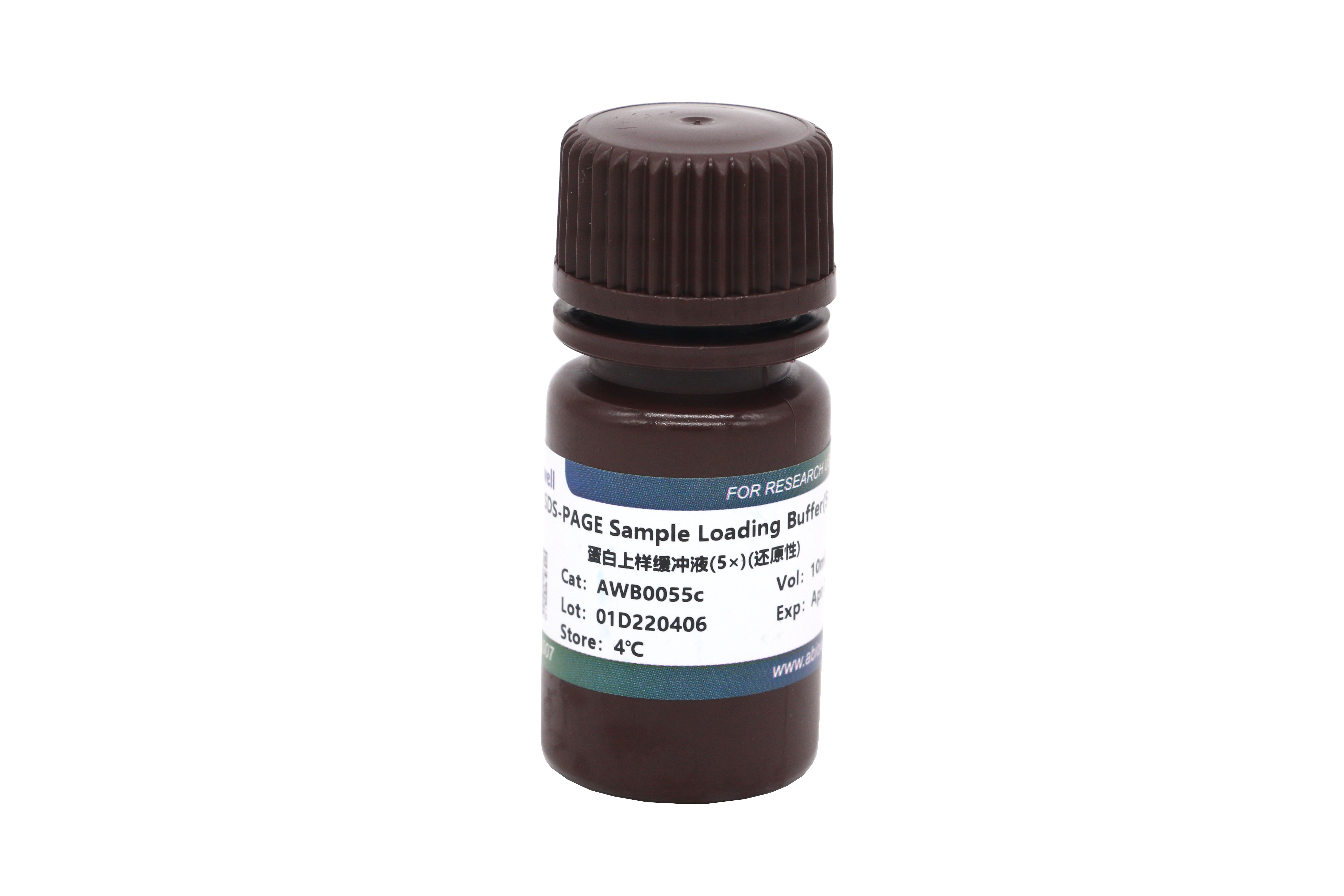
蛋白上样缓冲液(5×)(还原性)即SDS-PAGE Sample Loading Buffer(5×),是一种经过改良的以溴酚蓝为染料的5倍浓缩的蛋白上样缓冲液。
蛋白上样缓冲液(5×)(还原性)常用于SDS-PAGE蛋白样品的上样,含少量DTT,但不含有毒物质β-巯基乙醇。
使用方法
1、 在室温或不超过37℃的水浴中溶解蛋白上样缓冲液(5×)(还原性)。水浴溶解后立即室温存放,尽量避免长时间置于水浴中。
2、 取适量的蛋白样品和蛋白上样缓冲液(5×)(还原性)按4:1混合,充分混匀。
3、 100℃或沸水浴加热5~10min,以充分变性蛋白。
4、 冷却到室温后,直接上样到SDS-PAGE胶加样孔内即可。
5、 通常电泳至蓝色染料到达PAGE胶的底部附近即可停止。
注意事项
1、 蛋白上样缓冲液(5×)(还原性)中含少量DTT,有轻微刺激性气味,但不含有毒物质β-巯基乙醇。
2、 蛋白上样缓冲液(5×)(还原性)必须完全溶解后再使用。
3、 为了您的安全和健康,请穿好实验服并佩戴一次性手套和口罩操作。
4、 本产品仅限于专业人员的科学研究用,不得用于临床诊断或治疗,不得用于食品或药品,不得存放于普通住宅内。
产品组成
名称 | 货号 | 规格 | storage |
蛋白上样缓冲液(5×)(还原性) | AWB0055a | 1ml | -20℃ |
蛋白上样缓冲液(5×)(还原性) | AWB0055b | 5ml | -20℃ |
蛋白上样缓冲液(5×)(还原性) | AWB0055c | 10ml | -20℃ |
注意:
1.本产品仅供科研使用。请勿用于医药、临床诊断或治疗。食品及化妆品等用途。请勿存放于普通住宅区。
2.为了您的安全和健康,请穿好实验服并佩戴一次性手套和口罩操作。
3.实验结果可由多种因素影响,相关处理只限于产品本身,不涉及其他赔偿。
参考文献 (27)
Introduction Human beings and animals have been exposed to long-term artificial lighting environments to induce glucose metabolism disorder. Melatonin (MT) is involved in the regulation of glucolipid metabolism, and can prevent skeletal muscle wasting as well as sarcopenia-associated diseases. However, the effect of exogenous MT on skeletal muscle glucose metabolism and the involvement of the parasympathetic pathway have not been clarified. Objectives: To investigate the role of parasympathetic regulatory pathway in the mediating the effects of exogenous MT on skeletal muscle glucose metabolism following long-term light exposure. Methods: This study established rapid growth period broiler models, while characterized muscle histological analysis, glucose metabolism indexes and related genes expression through parasympathetic activation, exogenous MT administration and exogenous MT with parasympathetic inhibition experiments. Results: Long-term light exposure inhibited muscle glycogen synthesis, promoted muscle glycogen decomposition, increased anaerobic glycolysis, decreased aerobic respiration and induced the injury in breast muscle. Parasympathetic activation and exogenous MT caused a marked improvement in muscle glycogen accumulation, aerobic glycolysis and the injury in breast muscle. The exogenous MT beneficial functions were alleviated by parasympathetic inhibition. Furthermore, parasympathetic activation and exogenous MT administration protected cecal microbiota homeostasis, by improving stability of the gut microbiota community and increasing the relative abundance of Lactobacillus . Lactobacillus abundance was positively associated with muscle glycogen accumulation. Conclusion: Taken together, this study highlighted the role of the novel parasympathetic regulatory pathway in the effects of exogenous MT in maintaining glucose metabolism homeostasis and restoring the damage in skeletal muscle with long-term light exposure. The results indicate that gut microbiota are involved in the MT-parasympathetic regulatory network. This study filles the gap in autonomic nervous-endocrine regulation under long light exposure, and provides a new insight to alleviate long light exposure-induced glucose metabolism disorders to improve the growth and health of humans and animals.
Background Prostate cancer (PCa) incidence and mortality rates are rising. Our previous research has shown that the combination of icariin (ICA) and curcumol (CUR) induced autophagy and ferroptosis in PCa cells, and altered lipid metabolism. We aimed to further explore the effects of the combination of ICA and CUR on gut microbiota, metabolism, and immunity in PCa. Methods A mouse subcutaneous RM-1 cell tumor model was established. 16 S rRNA sequencing was performed to detect changes in fecal gut microbiota. SCFAs in mouse feces, and the effect of ICA-CUR on T-cell immunity, IGFBP2, and DNMT1 were examined. Fecal microbiota transplantation (FMT) was conducted to explore the mechanism of ICA-CUR. Si-IGFBP2 and si/oe-DNMT1 were transfected into RM-1 and DU145 cells, and the cells were treated with ICA-CUR to investigate the mechanism of ICA-CUR on PCa development. Results After treatment with ICA-CUR, there was a decrease in tumor volume and weight, accompanied by changes in gut microbiota. ICA-CUR affected SCFAs and DNMT1/IGFBP2/EGFR/STAT3/PD-L1 pathway. ICA-CUR increased the positive rates of CD3 + CD8 + IFN-γ, CD3 + CD8 + Ki67 cells, and the levels of IFN-γ and IFN-α in the serum. After FMT (with donors from the ICA-CUR group), tumor volume and weight were decreased. SCFAs promote tumor development and the expression of IGFBP2. In vitro, DNMT1/IGFBP2 promotes cell migration and proliferation. ICA-CUR inhibits the expression of DNMT1/IGFBP2. Conclusions ICA-CUR mediates the interaction between gut microbiota and the DNMT1/IGFBP2 axis to inhibit the progression of PCa by regulating immune response and metabolism, suggesting a potential therapeutic strategy for PCa.
Background Xin-tong-tai Granule (XTTG), a traditional Chinese medicine, has been used to treat atherosclerosis (AS), but its mechanism is poorly understood. Intriguingly, oxidative stress has been recognized as vital factors in the treatment of atherosclerosis. Purpose This study aims to explore the potential mechanism of XTTG for treating AS. Methods An in-vivo model of AS was established by feeding ApoE -/- mice with a high-fat diet (HFD), and the Human Aortic Vascular Smooth Muscle Cells (HAVSMCs) were induced by oxidized low-density lipoprotein (ox-LDL) in vitro. After treatment, the blood lipid levels and pathological aortic changes of each group were observed, and the cell proliferation and lipid droplet aggregation in each group were evaluated. The oxidative stress indicators such as malondialdehyde (MDA) and superoxide dismutase (SOD) levels and related NOX/ROS/NF-κB signaling pathway indicators were observed. Results XTTG improved blood lipid levels and pathological aortic changes of ApoE −/− mice with HFD feeding, inhibited HAVSMCs proliferation and lipid droplet aggregation induced by ox-LDL, reduced MDA content, increased SOD content, inhibited NOX4 and p22phox protein expression, downregulated ROS content, inhibited IKK-α, IKK-β, NF-κB protein and mRNA expression and the phosphorylation of NF-κB. Conclusion XTTG can inhibit NOX/ROS/NF-κB signaling pathway, reduce damages caused by oxidative stress, and exert anti-AS effects.
Summary Hypoxic pulmonary hypertension (HPH) lacks effective pharmacologic treatments. Microarray-based gene expression indicates the crucial role of Cullin 5 (Cul 5) in HPH. This study showed that Cul 5 was upregulated in HPH patients and a murine model of HPH. In vitro , Cul 5 promoted the angiogenesis and adhesion capacity of human pulmonary artery endothelial cells (PAECs), which could be mitigated by Cul 5 inactivation mediated by pevonedistat or NEDD8 silence. In vivo , silencing of Cul 5 in the endothelium and Cul 5 inactivation by pevonedistat could also alleviate hypoxic vascular remodeling. Mechanistic research showed that Cul 5 participated in HPH pathogenesis via the TRAF6/NF-κB/HIF-1α/VEGF pathway. Inhibition of the TRAF6/NF-κB/HIF-1α/VEGF pathway could reverse Cul 5-induced human PAEC dysfunction. These findings demonstrate that Cul 5 is an important mediator of HPH via the TRAF6/NF-κB/HIF-1α/VEGF pathway firstly, and could be considered as a potential therapeutic target in the clinical treatment of HPH.
To date, extensive research has shown that heat stress disturbs glucose and lipid metabolism in broiler chickens. Recent evidence suggests that chromium supplementation influences metabolic regulation, particularly in glucose and lipid homeostasis in mammals. This study aimed to evaluate the effects of chromium picolinate supplementation on glucose and lipid metabolism in the breast muscle of broiler chickens under chronic heat stress. A total of 180 male Arbor Acres ( AA ) broilers (22 days old) were randomly assigned to three groups: a thermoneutral control group (21°C), a heat stress group (31°C), and a heat stress group receiving chromium picolinate (31°C + 400 μg/Kg elemental chromium). After 14 days, heat stress significantly impaired growth performance, induced insulin resistance, increased fat deposition, and suppressed the expression of key glucose and lipid metabolic genes. In contrast, chromium picolinate improved the average daily feed intake ( ADFI ), average daily gain ( ADG ), and reduced feed conversion ratio ( FCR ). It also upregulated glucose metabolism genes ( GLUT1, PI3K, GS ) and lipid metabolism genes ( PPARα, CPT-1, LPL ) in breast muscle. Overall, chromium picolinate alleviated heat stress-induced skeletal muscle glucose and lipid metabolism disturbances in broiler chickens.
Vascular regeneration dysfunction is key to the difficulty of healing diabetic wounds. Ferulic acid (FA) has been reported to be crucial in vascular regeneration. This work aimed to investigate the mechanism of FA in treating vascular regeneration dysfunction in diabetes. We investigated the impact of FA on wound healing and angiogenesis in diabetic rat wounds by injecting streptozotocin (STZ) into rats and excising full-thickness skin from the rats' backs. The effects of FA on the viability, migration, and angiogenesis of endothelial progenitor cells (EPCs) induced by high glucose (HG) were studied. Molecular docking and DARTS analysis of FA and HYAL1 were conducted. Knockdown and overexpression were utilized to investigate the regulatory mechanism of FA on diabetic angiogenesis. Metabolomics research was carried out to examine the regulation of serum metabolites by FA. The results showed that Intervention with FA resulted in smaller wounds in rats compared to the non-intervention group. The newly formed epidermis in rats after FA intervention was thicker, and the re-epithelialization rate and collagen deposition rate were higher. FA intervention increased the number of circulating EPCs in the peripheral blood of diabetic rats and enhanced the cellular activity, migration, and tube-forming capacity of bone marrow (BM)-EPCs. Upregulation of HYAL1 expression reduced the level of MMP-9, decreased the cell activity of BM-EPCs, and weakened the adhesion, migration, and vascular formation ability of BM-EPCs. Molecular docking and DARTS results showed that FA could bind to HYAL1 protein. HG intervention elevated the level of HYAL1, and FA intervention reversed the effect of HG intervention. FA intervention could regulate the metabolism of rats with diabetic wounds. In conclusion, FA enhanced the wound healing process and promoted vascular genesis in diabetic rats by suppressing HYAL1 and enhancing the function of BM-EPCs in diabetes. Graphical In diabetic wound rats, ferulic acid (FA) targets HYAL1, downregulates its expression, and subsequently upregulates MMP-9, thereby enhancing the function of bone marrow-derived endothelial progenitor cells (BM-EPCs) and promoting angiogenesis.
Prolonged light periods resulted in up-regulation of cecal 5-hydroxytryptamine ( 5-HT ) synthesis and secretion, disorders of breast muscle glucose metabolism and alteration in gut microbiota composition. The present study was conducted to investigate the effects of cecal microbiota on peripheral 5-HT metabolism and breast muscle glucose metabolism in broiler chickens underlying prolonged light periods. A total of 144 5-day-old male Arbor Acres ( AA ) broiler chickens were randomly divided into four treatment groups i.e., 12 hours light: 12 hours dark ( 12L:12D ) photoperiod group, 18 hours light: 6 hours dark ( 18L:6D ) photoperiod group, 18L:6D photoperiod with phosphate buffered saline ( PBS ) solution administration group ( 18L:6D+PBS ) and 18L:6D photoperiod with cecal microbiota transplantation ( CMT ) group ( 18L:6D+CMT ) for 14 days. The results demonstrated that the 18L:6D photoperiod increased breast muscle rate ( P < 0.05) but induced the morphological damage of breast muscle, dysregulation of breast muscle glucose metabolism and higher peripheral 5-HT synthesis ( P < 0.05). In contrast, CMT significantly improved breast muscle weight and breast muscle ratio while reducing the breast muscle injury. Furthermore, CMT alleviated glucose metabolism dysregulation, as evidenced by significant reductions in serum glucose ( P < 0.05), insulin ( INS ) ( P < 0.05), homeostasis model assessment of insulin resistance ( HOMA-IR ) ( P < 0.05), and the lactic acid-to-pyruvate ratio ( L/P ) ( P < 0.05), as well as an increase in muscle glycogen concentrations ( P < 0.05). Additionally, the expression of glycogen synthase ( GS ), pyruvate dehydrogenase ( PDH ) and glucose transporter-4 ( GLUT4 ) up-regulated, while the expression of glycogen phosphorylase L ( PYGL ), hexokinase ( HK ), 6-phosphofructokinase ( PFK ), pyruvate kinase ( PK ) and lactate dehydrogenase ( LDH ) down-regulated ( P < 0.05) in breast muscle of CMT-treated broiler chickens. Notably, both peripheral 5-HT concentrations and cecal 5-HT synthesis was significantly reduced ( P < 0.05) in the 18L:6D+CMT group. In summary, these findings indicate that CMT promotes breast muscle rate, reduces breast muscle injury, alleviates breast muscle glucose metabolism disorder in broiler chickens exposed to prolonged light periods. Moreover, peripheral 5-HT metabolism may serve as a key pathway through which cecal microbiota regulates skeletal muscle glucose metabolism.
Background Xin-Tong-Tai Granule (XTTG), a Chinese medicine (CM) formula, has demonstrated significant therapeutic effects on atherosclerosis (AS) in both clinical and experimental settings. Nonetheless, the mechanisms underlying XTTG’s efficacy remain largely unexplored. This study aimed to elucidate the mechanisms through which XTTG acts against AS, employing network pharmacology, molecular docking, and experimental validation techniques.Methods Initially, target identification for the main chemical components of XTTG was conducted using database, followed by determining the intersection targets between these compounds and disease. Protein-protein interaction (PPI) network analysis, Gene Ontology (GO) enrichment, and Kyoto Encyclopedia of Genes and Genomes (KEGG) pathway analyses were subsequently utilized to investigate the potential pathways through which XTTG exerts its effects on AS. Molecular docking was done to confirm the binding efficacy of XTTG’s active components. Additionally, the effects of XTTG were evaluated in vitro using oxidized low-density lipoprotein (ox-LDL) induced human aortic vascular smooth muscle cells (HAVSMCs) and in vivo in apolipoprotein E gene knockout (ApoE−/−) mice fed a high-fat diet (HFD).Results 229 therapeutic targets were screened for PPI network and enrichment analysis. Notably, the nuclear factor kappa-B (NF-κB) signaling pathway, along with processes related to inflammation and autophagy, were significantly enriched, highlighting their importance. In vitro studies showed that XTTG repressed cell proliferation and lipid droplet aggregation in ox-LDL-induced HAVSMCs. It also decreased the ratio of phosphorylated NF-κB p65/ NF-κB p65, tumor necrosis factor-α (TNF-α) and interleukin-6 (IL-6) levels, and elevated microtubule-associated protein light chain 3 (LC3) and decreased p62 protein expression. In vivo, XTTG ameliorated blood lipid profiles and aortic pathology in HFD-fed ApoE−/− mice, reduced NF-κB p65 expression and serum levels of TNF-α and IL-6, increased the ratio of LC3II/LC3I while decreasing p62 protein expression.Conclusion XTTG mitigates AS primarily through anti-inflammatory and autophagy-modulating mechanisms, particularly via inhibition of NF-κB p65 expression. These findings underscore the potential of CM in treating AS and support its further clinical exploration.
Keratoconus (KC) is a prevalent ectatic corneal disease and the leading cause of corneal transplantation globally. Despite evidence of mitochondrial abnormalities in KC, the underlying mechanisms remain unclear. Our aim was to investigate the role of mitochondrial dysfunction in this pathological condition. Based on transcriptomics datasets of KC, mitochondria-related differentially expressed genes (mDEGs) were identified and analyzed for potential functional pathways, protein-protein interaction (PPI), and gene regulatory networks. Hub genes were further screened and validated by multiple machine learning (ML) algorithms, followed by a comprehensive visualization of single-cell atlas and immune landscape. Additionally, bioinformatic results were validated through quantitative PCR, Western blot, and transcriptomics analysis in an in vitro KC model based on matrix stiffness using human stromal keratocytes. In total, 104 mDEGs were identified, enriched in pathways related to oxidative stress, apoptotic mitochondrial changes, ferroptosis, and inflammatory responses. Nine characteristic genes (CYP24A1, ACSL4, ACADL, HELZ2, AMT, DEPTOR, TUBA1A, TYMS, and ACSL5) were selected and validated using multiple ML models. Single cell sequencing data highlighted ACSL4 as the most promising biomarker, primarily expressed in corneal stromal cells (CSCs). Immune infiltration analysis revealed that ACSL4 was positively associated with monocytes and negatively correlated with eosinophils in KC. In cellular experiments, ACSL4 expression was significantly upregulated in response to decreased substrate stiffness, suggesting its critical role in KC development. These findings suggest a mitochondrial-related molecular mechanism implicated in KC pathogenesis. The identified pivotal biomarker ACSL4 provides a novel framework for future mechanistic and therapeutic studies of KC.
While the association between smoking and accelerated facial aging is well documented, the specific pathways underlying this association remain poorly understood. To investigate the shared genetic architecture between smoking and facial aging, we performed genetic analyses based on genome-wide association studies (GWAS) data. These analyses included linkage disequilibrium score regression (LDSC), pleiotropic analysis under composite null hypothesis (PLACO), functional mapping and annotation (FUMA), and multi-marker analysis of genomic annotation (MAGMA). To further explore the shared target genes, we utilized expression quantitative trait loci (eQTLs) and mediation Mendelian randomization (MR) analysis, with subsequent validation conducted through in vitro experiments using NIH/3T3 cells. Additionally, we carried out pan-cancer correlation analyses to assess the broader implications of the identified genes in cancer biology. Through pleiotropy and colocalization analyses, IREB2, along with CHRNA5 and AARS1, were identified as having strong evidence linking smoking and facial aging. Functional enrichment, tissue-specific analyses, and gene co-expression network were conducted to further elucidate the functions of these genes. Following eQTLs and mediation analyses, IREB2 was identified as a potential mediator connecting smoking to facial aging. Cellular experiments demonstrated that exposure to cigarette smoke particles induces cellular senescence and downregulates IREB2 expression. The pan-cancer analysis highlighted IREB2's role in shaping the tumor microenvironment and influencing immune processes. This study identifies IREB2 as a critical factor in the molecular mechanisms by which smoking accelerates facial aging, while also contributing to tumor development and immune evasion. Further functional exploration of IREB2 could uncover new therapeutic avenues to address these interconnected conditions.